Tuesday, October 31, 2017

Why the traditional leisure class no longer exists


Without a doubt, we live in the most prosperous times in human history. Even low income earners in our society have access to luxuries and comforts far greater than those even 50 years ago. The age of technology has overall, made the lives of everyone better. That being said, levels of inequality in this day are higher than they have been for the past 90 years or so. The concept of the "Leisure Class" as discussed by Thorstein Veblen highlighted a social group existing in opulence in the 19th century. However the existence of this class in the 21st century has diminished and no longer exists (with exception).

The Leisure class is a group of individuals that live in a life of opulence and excess but work little to achieve such luxuries. The concept is based from feudal times with the wealth of aristocracy not being earned, but leading to lives of lavish consumption. Leading into the modern era, with the industrial revolution, the leisure class could be described as the new heads of industry, who own the means of production. However while their life styles may have been classified as "leisurely", one may argue that leisure class is dead. The industry creating the most billionaires is investment, with examples of George Soros and Warren Buffet standing out. These individuals created their wealth themselves, working hard in the process. While they may lead lives of comfort now, the journey to this place took work. Entrepreneurs such as Bill Gates and Jeff Bezos are icons of extreme wealth. They created their own fortunes through a mixture of lucky and ingenious ideas. The new uber rich in most cases created their fortunes themselves through work, thus in my opinion, do not classify as the leisure class. The amount of years of work that were needed to lead to these fortunes, show that in today's world, wealth isn't necessarily a right given to a group who squander it in frivolous enjoyment, but through creating new concepts or clever investment strategies.

That being said, those on top still enjoy a level of comfort and quality of life that one cannot imagine. The amount of wealth accumulated by these people is truly staggering. Significant amounts of luck can be accredited into the success of these people, but to dismiss the work put behind some of these ventures is ignorant.

The ultra rich will always exist. In 2017, the richest individuals own most of the worlds resources and capitalize on this to great success. The leisure class as described in "Conspicuous Consumption" exists only on the bare fringe of the small group of wealthy. The modern aristocracy are a small, powerless group that are just a reminder of our feudal past. The modern leisure class are those who through smart decisions, hard work and luck built fortunes that keep expanding. Their wealth is always subject to change. They spend their wealth with flare but the work required to accumulate and maintain the lifestyle makes them an elite group but not a group defined by leisure.

“Capital in the Twenty First Century” By Thomas Piketty 


 Piketty sets out to develop society’s understanding of inequality in a historical context so that we can learn to deal with inequality today, he proposes a much deeper analysis of inequality, with access to more than three centuries of data ranging twenty countries. Piketty introduces the views Karl Marx and Simon Kuznets who bitterly disagreed on the topic of inequality. Marx principals suggest that inequality is always increasing and by definition the  world is becoming unjust, whereas Kuznets believes that over time inequalities is naturally decreasing regardless of economic policy. His evaluation of both views shows that there supporting evidence is insufficient based on theoretical speculation. Therefore it is necessary to use the data available to give greater insight into inequality.


His finding show the decline in inequality during 1910-1950 was due to the post war consensus that was adopted to deal with the shocks of war. Then the return of rising inequality from the 1980’s was due to political shifts as taxation became more regressive.


His second conclusion there are powerful dynamic alternating forces resulting in reduction and growth in inequality. The main force for reducing inequality is education and the diffusion of eduction and training; as seen by the development of previously poor countries such as China and India which are emerging as world powers. This has been archived by adopting production methods of wealthy countries and acquiring comparable skills. Another factor that reduces inequality is progress in medicine and improved living has changed the nature of inequality. However Piketty dismisses these ideas as optimistic, as divergence factors are much more prevalent. As long as the return on private capital (interest rate) exceeds the growth rate of an economy then inherited wealth will grow faster than incomes, he explain this with the equation r >g( http://piketty.pse.ens.fr/files/capital21c/en/pdf/F10.9.pdf)Therefore slow economic growth results in increasing inequality and the more wealth someone owns, the faster that wealth grows. Between 1987 and 2013 the rate of return owned by the average adult was 2.1% whereas the average millionaire was 6.1%.


Piketty proposed to bring the question of wealth distribution back to the forefront of economics, considering the rapid growth of inequality in developed economies. Noting his inability to foresee where capital will go in the future he states  government must use progressive taxation of wealth to redistribute incomes to reduce inequality, however his policy proposal have been criticised for been ideologically rather than economically driven and could do more damage than good. 

https://www.economist.com/news/leaders/21601512-thomas-pikettys-blockbuster-book-great-piece-scholarship-poor-guide-policy?fsrc=explainsdig


Monday, October 30, 2017

Is inequality a necessary evil of capitalism?


Is inequality a necessary evil of capitalism?

"Capital in the Twenty First Century” By Thomas Piketty

Picketty attempts to answer substantial economic questions presented about inequality. Is inequality a result of capitalism or does the advancement in technology lead to reducing this gap of inequality. Piketty aims to provide theory of political economy, specifically the idea of distribution and how that has huge precedence within our society and in doing so provide a different perception on economic growth and what its trajectory would entail. Piketty's best feature in attempting to answer such questions is a wealth of data, such data covering 3 centuries across 20 different countries.
The central idea of the book is that inequality is a feature of capitalism, and can only be rectified through government intervention. The book argues that unless radical changes to capitalism occurs, the very much democratic element of capitalism itself will be void. However is enough being done by the state and how that intervention should come about? The main idea given by the data overall says inequality will get worse overtime which is a huge problem.
The focus is on changing the details of our tax system as this directly contributes towards the objective of distribution and allow for income inequality to be reduced.

The main argument in Capital for why wealth inequality is set because of r > g. This formula states that the rate of return on capital exceeds the growth of output. meaning that the return of capital is growing at a larger rate than that of national incomes or workers showing that overtime a 'superwealthy' class who live of such assets without directly contributing to an economy occur result in a greater effect on inequality.

Key Quotes:
“capitalism automatically generates arbitrary and unsustainable inequalities that radically undermine the meritocratic on which democratic societies are based.” However he does go on further to state how democracy does have the tool to make general interest take priority over private interest. Is enough being done about inequality?
“When the rate of return on capital significantly exceeds the growth rate of the economy (as it did through much of history until the nineteenth century and as is likely to be the case again in the twenty-first century), then it logically follows that inherited wealth grows faster than output and income”

Does inequality serve a purpose?
Market economies rely on the price mechanism to allocate resources within that market. Such resources reflect demand and supply. E.g. rising wages incentivise labour to become more ‘attractive’/employable. Inequality therefore acts as an incentive to provide those goods and services that the market wants.
Those who are not as in favour of unregulated markets point out the need for such huge wage difference are not need and that only minor changes to such income would result in sufficient incentives to reward. E.g. footballer on a wage of £5000 a week would still attract young player to become professional players 

http://www.economicsonline.co.uk/Managing_the_economy/Inequality_and_equity.html

Policies to reduce inequality
Horizontal and Vertical equity
Horizontal equity is somewhat a guideline for tax and benefits policy, individuals in similar financial circumstances should be taxed at the same rate.
The principle of vertical equity suggests that, when individuals are in different circumstances and have different abilities to pay, they should not be taxed at the same rate.

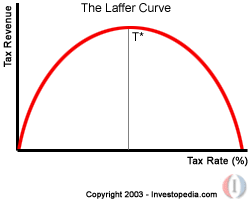
Image result for laffer curve
Taxation plays a huge role in inequality as the main source of problem of inequality is distribution, so therefore through government polices such as benefits and taxation play a huge role in combatting inequality. Progressive taxation can be seen as highly beneficial as it would allow for injections into other sectors as it would generate high level of revenue. However when concerning tax rates, the Laffer curve can  be used as to show that when tax rates reach a certain level, the revenue received from these taxes decreases due to avoidance and evasion.

Are such issues being addressed and if so how effective have they been, taxation is a widely debated topic however are wealthier people being taxed enough or is tax avoidance a bigger problem?

Is inequality a feature of capitalism if so to what extent should we have inequality?

Is government intervention enough or does a new form of capitalism need to occur?


Monday, October 23, 2017

Could the digital generation become the generation of genuine democracy?


In his work The Public and it’s problems: An essay in political enquiry, John Dewey casts doubt on the efficacy of democracy without successfully representative participation from the civilian population. However, he also suggests how the reality of a democratically organised public may be non-existent. A prevalent issue for this idealistic concept is that questions of science, agriculture, industry and finance are highly technical and complex that often crucially require expert advice. With the running of a country concerning matters from sanitation to taxation, inquiries and analysis must be carried out by those trained and equipped. It is without doubt that this means the role of professionals, academics and policy experts are invaluable within government. But with such a vast population, so many people and so much public concern, out of this we must question how many people are competent to measure all the factors involved in reaching a decision? How many have the facts and resources available? How many have the time to devote to it? And how many actually want to? 


Image result for people using smartphones

              Dewey recognises the open scepticism about the effect of voting expressed by the general public: “What difference does it make?” and “My vote never changed anything.” These phrases are still recognisable today, voicing the kind of pessimism that fuels voter apathy as people become more and more disillusioned with their personal impact in their country’s politics. Dewey also noted that it doesn’t require much reflection to realise that the only real decision the public is ever involved in is the choice of who gets the title of prime minister and realistically, this is only ever really a choice between two. This centralising movement presents the citizen with the illusion of choice but does very little for the voice of the individual. Despite this, the youth turnout in the most recent UK general election was at its highest in 25 years: 64%. It's unlikely you'd hear any student with a twitter account claiming that the youth are uninterested in politics. With the current world population at 7.6 billion and residents of the United Kingdom making up 66,573,504 of that, Dewey’s problem with a public ‘too diffused and scattered and too intricate in composition to identify and collaborate' is only more pressing today than when he wrote of it in 1927. So, in an age of advancing technology, mass communication and government bureaucracy- how is the public making its voice heard? 
               Plato said that a genuine state could hardly be larger than the number of persons capable of personal acquaintance but with social media and smartphones, the concept of a community is no longer rooted in geographical location and instant worldwide communication is as simple as pressing a button. With this in mind, surely governing bodies and citizens alike could use the internet as a platform for improving democratic method? But alas, this is not the case yet. In order for the government to be truly democratic, it must effectively combine expert theory and direct public influence. But as of currently, methods of influencing government from the public perspective is largely unsuccessful. Unions and petitions are often lost in the archaic procedures of getting a bill through parliament, protests and rallies often ignored and even professional opinions sometimes neglected. For example, in the education sector, over many years the government would publish the consultation documents for the national curriculum on the last day of the summer term with responses required on the first day of the new academic year. Unsurprisingly, the responses were limited. 
               Personally, I think that the public needs to show more interest in politics in general but I’m not surprised at the lack of care when there so often appears an in-congruence between popular public opinion and government decisions despite claims that the party in power is representing the people. According to Ofcom.org.uk, 94% of adults in the UK personally own/use a mobile phone. With globalised social media platforms giving such effective momentum to social change such as the Black Lives Matter movement, if there were, hypothetically, an app or website that allowed the government to share information for consultation and receive responses, it is undeniable that this modern method would make politics more accessible to the masses. 

Saturday, October 14, 2017

Single-issue politics and Elitism

It is often argued that with developing democracies nepotism and elitism should slowly disappear with quality and 'fairness' of lives of the society.
Today in the modern world elitists are still considered powerful enforces of government policy and changing the minds of voters through 'investment' to secure their own interests - whether they are from a business or political background (and in 'rare' cases both). So in that sense politics does offer 'business opportunities' no matter how secure and accountable the system in place is perceived, at least from the public point of view which we are led to believe. In this sense one can say (bureaucrats/politicians) that state secrets and security for the people is of upmost importance.

Alan Milburn who is a British (Labour) politician, also the Former Secretary of State for Health (1993-2003) has stated in his statement to the media, that the 'inequality of social mobility is due to entrenched elitism' and has been 'for decades in the making'. This point is justified by the historical aspects of the ages, it wasn't until the end of the second world war that we saw increased economic prosperity and a sense of nationalism and crippling empires. Naturally this led to political turmoil and demand from the public in many nation states which led to even more instability where demands are not taken in a serious tone. Thus giving root to military coup and resistance outfits. (Honduras - rising poverty and inequality).

Milburn then argues that elitism cannot be blamed on one party due to limited time of party rule - 'that prevents them from addressing the deep-rooted causes of inequality and social immobility in the UK'. This in sense, shows that even if nationalistic views are enforced, they cannot be just 'regular' but take a more extremist view, as we see in US today (such as white-nationalism).
To combat elitism, the commonly known solution of reducing taxation from labour class and imposing higher taxation on corporations would mean more income for the working class thus reducing the gap. This we can experience at times of high demand which changes with every party in power, but the national interest of improving the economy rather than addressing issues of inequality of income remains unattended. Of course if politicians (in any country) of course not all, addressed the issue of inequality and rising wages and shifting the taxing system toward the so called elitists and businesses, it will benefit some groups or industries for some time without long-termism, but of course a core issue must be taken by the political parties to the people so that they may be voted in power, but if that solution is not implemented to the laying problem, it would mean a change in who gets to be the torchbearer.

A recent study by Princeton University Prof Martin Gilens and Northwestern University Prof Benjamin conducted data of oligarchism in US.

They conclude by saying that
"Multivariate analysis indicates that economic elites and organised groups representing business interests have substantial independent impacts on US government policy, while average citizens and mass-based interest groups have little or no independent influence".


US probably has the highest number of lobbying firms and perhaps the most expensive, their job is exactly of the client, but they have what the client does not, persuasion, contacts and their Pandora’s box. Whether they agree with the client's view they must enforce the views of their client to the appropriate entity, this can be a national department or the white house when it comes to policy making.
https://www.opensecrets.org/lobby/top.php?indexType=l

The research started with 1,779 survey question presented between 1981 and 2002 on public policy issues, these were analysed for income level and often certain income levels and organized groups had their policy preferences implemented or represented.
"A proposed policy change with low support among economically elite Americans (one-out-of-five in favour) is adopted only about 18% of the time," they write, "while a proposed change with high support (four-out-of-five in favour) is adopted about 45% of the time."
"When a majority of citizens disagrees with economic elites and/or with organised interests, they generally lose"

This goes to show that politicians in US often rely on the social and political environment for guidance of which issues they should carry to victory, even after assuming office, politicians supported by elitists and organized groups will be looking to lobby for their own interests. Its the question of actual implementation, as it not just involves one leader looking to win an election, but the environment after in which the policy is adapted which involves various groups and individuals.

Stanley Aronowitz discusses in the article series of The Power Elite. He mentions that the powerful elite and chief executives of corporations should be seen as distinct from each other. The elite are the original players and then come chief executives who are employees with high salaries - under the direction of a Board of Directors. Implying the tool of power and how often these two are associated within actual practice. And the nexus between corruption, politicians and elitism revolves around this theory, and answers the question why and how elitism and its legacy continues. "Chief executives are ostensibly high salaried employees under the direction of a Board of Directors which, in the largest corporations, often appears as a cross-section of the economic elite, not only of the particular firm."
"What is significant about the managerial reorganisation of the propertied class is that by means of it the narrow industrial and profit interests of specific firms and industries and families have been translated into the broader economic and political interests of a more genuinely class type.  Now the corporate seats of the rich contain all the powers and privileges inherent in the institutions of private property."

The original theory of property ownership no longer defines economic power in the modern world (1932, Berle and Means) is theory of importance, the mind-set of that time and the growth of democracy, of 'equality for all'. The current modern world as we see, property ownership plays an important role of social perception and which had never changed, the original elites build reputation and form a chain of contacts in which they protect their interests, the same goes for all members, the continuance of the elitist legacy would be attributed with the continued social link of that which is the elite.

Monday, October 9, 2017

The Great Paradox: Why States Vote Red

Across the world right now, charismatic leaders are defying expectations and polarizing fragile democracies. Claiming to represent ‘The People’, populists harness fear, hate and lies to pursue their personal agendas, neatly packaged as contempt for ‘The Elites’. Of course, it is ‘The People’, often poor, less educated and fed up with a system that concentrates power in the hands of a few, who end up bearing the brunt of their actions. What is so baffling, is how the people who are most in need of government support, end up turning to far-right groups who seek deregulation and minimal government intervention. How let down must people feel before they decide to elect a multi-billionaire reality TV star? Why would a multicultural, modern economy such as Britain, want to close its doors to the world's largest trading block?

Progressive liberals in the cities hold their heads in their hands as the unthinkable happens and society collapses around them, unable and perhaps unwilling to empathize with the not-so-silent majority. So disengaged are the opposite political camps these days, that in 2010, in a pair of surveys asking Americans whether they would be “upset” if their child married someone from another party, 40% expressed dismay. Contrast this to a similar survey undertook in 1960, where the result was only 5%, and questions soon arise.

In her new book, Strangers in Their Own Land: Anger and Mourning on the American Right, the renowned sociologist, and academic, Arlie Russell Hochschild, attempts to see, and more importantly, feel life from the viewpoint of the American right. As professor emerita of sociology at the University of California, Berkeley, she is continually immersed in the liberal lifestyle. To get the full picture, she travels to the Dixie state of Louisiana to soak up the culture and interview members of the Tea Party, a grassroots, conservative movement that promotes Judeo-Christian values and low taxation by reduced government spending. Over a total of 5 years, she accumulates 4,690 pages of transcripts based on interviews with 40 active Tea Party members and 20 more non-members who broaden her perspective.

In part 1 of her book, Hochschild tries to come to terms with why the Red States, with their high poverty rates, poor education and, most alarmingly, shorter life expectancy, “the gap in life expectancy between Louisiana (75.7) and Connecticut (80.8) is the same as that between the United States and Nicaragua.”, are so averse to federal aid. She refers to this as “The Great Paradox”. Indeed, it seems bizarre and contradictory that many Tea Party members, being small business owners themselves, get behind politicians who seek to push policies that would allow conglomerates to devour their own.

In his piece for the New York Times, Who Turned My Blue State Red?, Alec MacGillis argues that disadvantaged citizens of Red States who use democrat-style “safety-net programs” like Medicaid, don’t turn up to vote, but those who are of a slightly higher class, typically seeking lower taxes, do. It's an interesting perspective, but as Hochschild outlines in her book “This “two notches up” thesis gives us part of the answer, but not most. “. Thomas Frank's theory is also brought into question, he suggests that the rich dupe gullible conservatives by targeting their social issues, serving them as a kind of side dish to the main economic policies they truly want to pursue, for example, Frank writes “Vote to stop abortion: receive a rollback in capital gains taxes. . . .”. Hochschild argues that this is too simple an idea, backed up by likes of people like Mike Schaff, a tea party member she met with in Louisiana, a well-educated man who “consulted a number of news sources” and didn’t feel like he was being "duped".

In her research for the book, Hochschild reads over many an academics’ answers to the Great Paradox, but finds they all lack in one thing, “a full understanding of emotion in politics.”. Through her interviews and encounters with citizens of the deep south, one can safely assume that these are people who feel left behind by Washington, tired of being told how they are supposed to feel by liberals a thousand miles away, whether it is around Gay Marriage, or the suffering felt by a Syrian refugee. When you are consistently being labeled by the establishment as trailer trash and a redneck, it becomes easy to see how Donald Trump, with his anti-government rhetoric and bluster, can be so appealing.


Dismantling the gender binary is an anti-capitalist, decolonising act, I hear you cry!? YES, and let me tell you how!

ok, so how is feminism linked to capitalism, Polanyi’s argument of inherently flawed free markets and where on earth does the gender binary come in?

“society resists being thought as a natural unity (like an organism or body) or as one that is closed by a structure, like patriarchy or capitalism, around a central antagonism or fundamental relation. Rather society can be seen as transiently and partially unified by temporary fixings of meaning” – The End of Capitalism as We Knew It by Gibson-Graham

Here Graham and Gibson are introducing the idea of plurality of identity. We are not just one fixed thing but instead, both individually and societally transient. This is where can start to talk about the similarities between feminism and anti-capitalism. The authors go on to explore the idea that when the identity of man is defined rigidly and with dominance (patriarchy) then it becomes possible to create woman in opposition to man. Woman can no longer stand alone as an identity, woman is instead created as non-man, a singular definite opposite, and thus is born THE GENDER BINARY.

Text Box: “They wanted black women to conform to the gender norms set by white society. They wanted to be recognized as 'men,' as patriarchs, by other men, including white men. ― bell hooks, We Real Cool: Black Men and Masculinity

However, when the identity of man is created as plural and indefinite, Man can be anything. Logically non-man can’t exist, neither as a singular opposite, nor as a subordinate of man (or at all really). Woman can become its own plural identity, capable of anything as well!

it’s not coincidental that the people in these images are white. Western binary gender norms and beauty standards have been a central method of control in colonial domination. Here bell hooks attests to the plurality of the functions of gender binary not just contributing to holding power over women but simultaneously complicit as a tool of upholding a white supremacist society.

 
TOP TIP!
Currently at the Tate Britain is an exhibition including Keith Pipers “go west young man” social and cultural readings of the black male body and investigating the production of gendered racial stereotypes during and after slavery.
discussing


Lead initially by Maria Lugones’s essay the Coloniality of Gender we come to The Invention of Women by Oyéronké Oyewùmí where she writes that she

“understands gender as introduced by the West as a tool of domination that designates two binarily opposed and hierarchical social categories…Women are defined in relation to men, the norm.”

Oyewùmí, hooks and Piper all attest to the colonial aspect of gender binaries as a tool of control. Gibson-Graham discuss how gender binaries are used as a method of control to keep the production of labour rolling in a capitalist system. e.g. men working, women at home raising children.

So wait! How does this all link to capitalism and free markets?

The next point that Gibson-Graham make is that capitalism has created a singular unified narrative around its self. The global (capitalist) economy is the new realm of the absolute…” capitalism becomes the everything, everywhere of contemporary cultural representation.”
Capitalism forms its self-identity (like our example of man) singularly, not as a multi-faceted economic discourse among other discourses, but as THE economic discourse!
In the same way that woman in binary opposition to man becomes non-man, so other economic discourses become non-capitalism and subordinate in relation to capitalisms dominance.

So in order to understand the links here, we can call on Polanyi’s argument as proof of the plurality of capitalism. Polanyi says that the capitalist free market is inherently flawed, being built on the fictitious commodities of labour, land and money. This statement highlights a contradiction in capitalisms singular identity as a functioning economic model. To be a contradiction you must be at least two things, so therefore free market capitalism has pluralities! When capitalism is read as plural, then other economic discourses are re-legitimised as viable and not just oppositional to capitalism.

In order to even the playing field, we must deconstruct the mutually supporting structures of patriarchy, expressed as gender binary and the singularity of a capitalist free market as a dominant narrative. Thus, re-contextualising capitalism as just another economic discourse and  gender binaries, not a tool of control but instead gender being a expression on a diverse spectrum.