Is inequality a necessary evil of capitalism?
"Capital in the Twenty First Century” By Thomas Piketty
Picketty attempts
to answer substantial economic questions presented about inequality. Is
inequality a result of capitalism or does the advancement in technology lead to
reducing this gap of inequality. Piketty aims to provide theory of political
economy, specifically the idea of distribution and how that has huge
precedence within our society and in doing so provide a different perception on
economic growth and what its trajectory would entail. Piketty's best feature in
attempting to answer such questions is a wealth of data, such data covering 3
centuries across 20 different countries.
 The
central idea of the book is that inequality is a feature of capitalism, and can
only be rectified through government intervention. The book argues that unless
radical changes to capitalism occurs, the very much democratic element of
capitalism itself will be void. However is enough being done by the state and
how that intervention should come about? The main idea given by the data
overall says inequality will get worse overtime which is a huge problem.
The
central idea of the book is that inequality is a feature of capitalism, and can
only be rectified through government intervention. The book argues that unless
radical changes to capitalism occurs, the very much democratic element of
capitalism itself will be void. However is enough being done by the state and
how that intervention should come about? The main idea given by the data
overall says inequality will get worse overtime which is a huge problem.
The focus
is on changing the details of our tax system
as this directly contributes towards the objective of distribution and allow for income inequality to be reduced.
The main argument in Capital for why wealth inequality is set because of r > g. This formula states that the rate of return on capital exceeds the growth of output. meaning that the return of capital is growing at a larger rate than that of national incomes or workers showing that overtime a 'superwealthy' class who live of such assets without directly contributing to an economy occur result in a greater effect on inequality.
The main argument in Capital for why wealth inequality is set because of r > g. This formula states that the rate of return on capital exceeds the growth of output. meaning that the return of capital is growing at a larger rate than that of national incomes or workers showing that overtime a 'superwealthy' class who live of such assets without directly contributing to an economy occur result in a greater effect on inequality.
Key Quotes:
“capitalism
automatically generates arbitrary and unsustainable inequalities that radically
undermine the meritocratic on which democratic societies are based.” However he
does go on further to state how democracy does have the tool to make general
interest take priority over private interest. Is enough being done about
inequality?
“When the
rate of return on capital significantly exceeds the growth rate of the economy
(as it did through much of history until the nineteenth century and as is
likely to be the case again in the twenty-first century), then it logically
follows that inherited wealth grows faster than output and income”
Does
inequality serve a purpose?
Market
economies rely on the price mechanism to allocate resources within that market.
Such resources reflect demand and supply. E.g. rising wages incentivise labour
to become more ‘attractive’/employable. Inequality therefore acts as an
incentive to provide those goods and services that the market wants.
Those who
are not as in favour of unregulated markets point out the need for such huge
wage difference are not need and that only minor changes to such income would
result in sufficient incentives to reward. E.g. footballer on a wage of £5000 a
week would still attract young player to become professional players
http://www.economicsonline.co.uk/Managing_the_economy/Inequality_and_equity.html
Policies to reduce inequality
Horizontal
and Vertical equity
Horizontal equity is somewhat a guideline for tax
and benefits policy, individuals in similar financial circumstances should be
taxed at the same rate.
The principle of vertical equity suggests that,
when individuals are in different circumstances and have different abilities to
pay, they should not be taxed at the same rate.
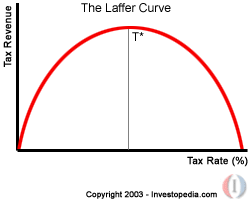 |
Taxation plays a huge role in inequality as the main source of problem of inequality is distribution, so therefore through government polices such as benefits and taxation play a huge role in combatting inequality. Progressive taxation can be seen as highly beneficial as it would allow for injections into other sectors as it would generate high level of revenue. However when concerning tax rates, the Laffer curve can be used as to show that when tax rates reach a certain level, the revenue received from these taxes decreases due to avoidance and evasion.
Are such issues being addressed and if so how effective have they been, taxation is a widely debated topic however are wealthier
people being taxed enough or is tax avoidance a bigger problem?
Is inequality a feature of capitalism if so to what
extent should we have inequality?
Is government intervention enough or does a new form of
capitalism need to occur?

No comments:
Post a Comment